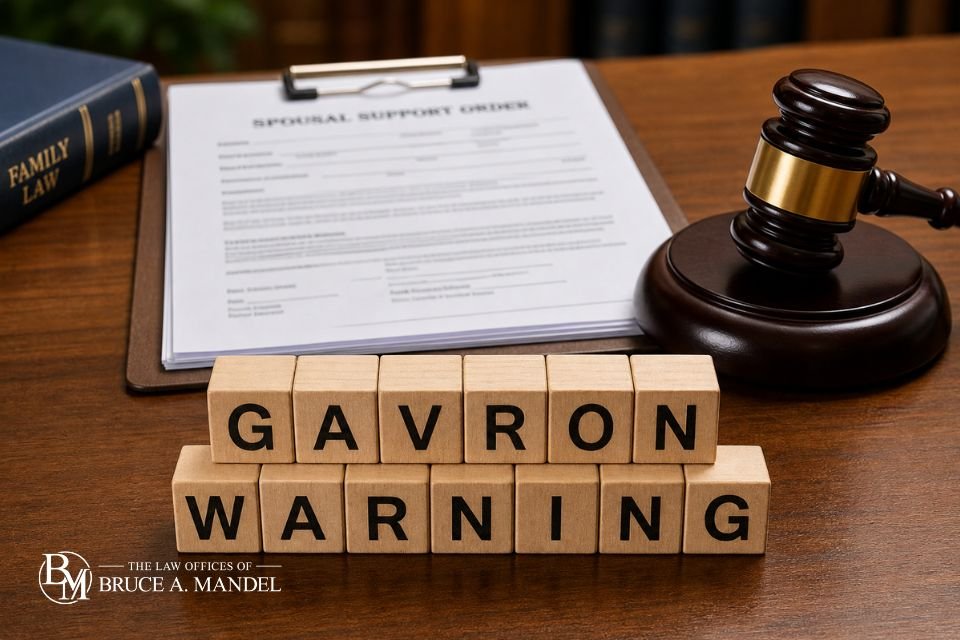
A Gavron warning may look like just one sentence in a California spousal support order, but it can shape how long support lasts and what the court expects from the supported spouse in the future. Understanding this warning helps both sides plan for life after divorce with clearer expectations about spousal support.
When spousal support is part of a California divorce, knowing how a Gavron warning works can prevent unpleasant surprises later. The Law Offices of Bruce A. Mandel helps clients see how a Gavron warning may affect future support modification, budgeting, and expectations about becoming more self-sufficient over time.
What Is a Gavron Warning?
A Gavron warning is a notice from the court telling the supported spouse that they are expected to make reasonable efforts to become self-supporting within a reasonable period. It grew out of a California appellate case and is now commonly built into spousal support orders. The warning can be spoken by the judge or written directly into the divorce judgment.
It does not set an exact deadline or demand instant full-time work. Instead, it signals that spousal support is usually not meant to be permanent income and that the court will later want to see real efforts toward earning capacity and financial independence.
Where a Gavron Warning Shows Up
A Gavron warning often appears when the court makes a spousal support order in a divorce or legal separation. It is especially common when the supported spouse has been out of the workforce, works part-time, or relies heavily on support.
You might see a Gavron warning:
- In the written divorce judgment or marital settlement agreement
- In a stand-alone spousal support order
- Stated by the judge at a hearing and then reflected in the written order
The wording can vary. The key sign is language that tells the supported spouse they are expected to contribute to their own support and work toward self-sufficiency.
How a Gavron Warning Can Affect Spousal Support
A Gavron warning does not by itself reduce or end spousal support. Instead, it sets the context for future decisions. If the paying spouse later asks to reduce or terminate spousal support, the court can review whether the supported spouse made reasonable efforts to become more self-supporting after receiving the warning.
When looking at a future request, judges often consider:
- Job search efforts and applications
- Steps taken to get training, education, or licensing
- Health, age, and caregiving responsibilities
- How long the supported spouse has been out of the workforce
If a supported spouse ignores realistic opportunities without a strong reason, the court may decide to reduce the spousal support amount or shorten how long payments continue, even if the paying spouse’s income has not gone up.
When a Gavron Warning May Be Limited
Courts have flexibility in how they use a Gavron warning. In many long-term marriages, or where a spouse has serious health issues or a very limited work history, a judge may decide that a strong warning is not appropriate or may soften the language. The expectations for self-sufficiency are often different for someone nearing retirement than for someone early or mid-career.
Judges can also consider whether a supported spouse needs time to finish school, complete retraining, or stabilize health before any real push toward employment makes sense. In those cases, the warning still puts the issue on the radar, but it may carry less weight in the near term.
What a Gavron Warning Means for the Supported Spouse
For a supported spouse, a Gavron warning is a signal to treat spousal support as a bridge, not a permanent plan. Helpful steps include:
- Keep a simple log of job searches and interviews
- Look into training or education that fits experience and abilities
- Save medical records if health limits work options
- Be realistic about what jobs and schedules are currently possible
These efforts can show the court that the spouse is taking the warning seriously. Good documentation may matter later if the paying spouse files to reduce or end spousal support.
What a Gavron Warning Means for the Paying Spouse
For the spouse paying support, a Gavron warning can be an important part of long-term planning. It creates a clearer path to ask the court to modify or terminate spousal support at a later date if the supported spouse does not move toward greater self-support and there is no good reason for that.
Paying spouses should:
- Confirm whether the spousal support order includes a Gavron warning
- Watch for changes in the supported spouse’s work, income, or education
- Revisit spousal support if circumstances change or a reasonable amount of time has passed since the warning
Moving Forward with Gavron Warnings in a California Divorce
A single sentence about self-sufficiency in a spousal support order can have long-lasting effects on both spouses’ finances. Knowing what a Gavron warning is, when it may appear, and how it ties into later support modification requests can help you negotiate wisely and plan more confidently for your financial future after divorce.
The Law Offices of Bruce A. Mandel works with clients to review existing or proposed spousal support orders, explain how a Gavron warning may affect them, and build strategies for both short-term and long-term financial stability. Spousal support decisions can shape life well beyond the divorce. Contact The Law Offices of Bruce A. Mandel to discuss your situation and next steps.