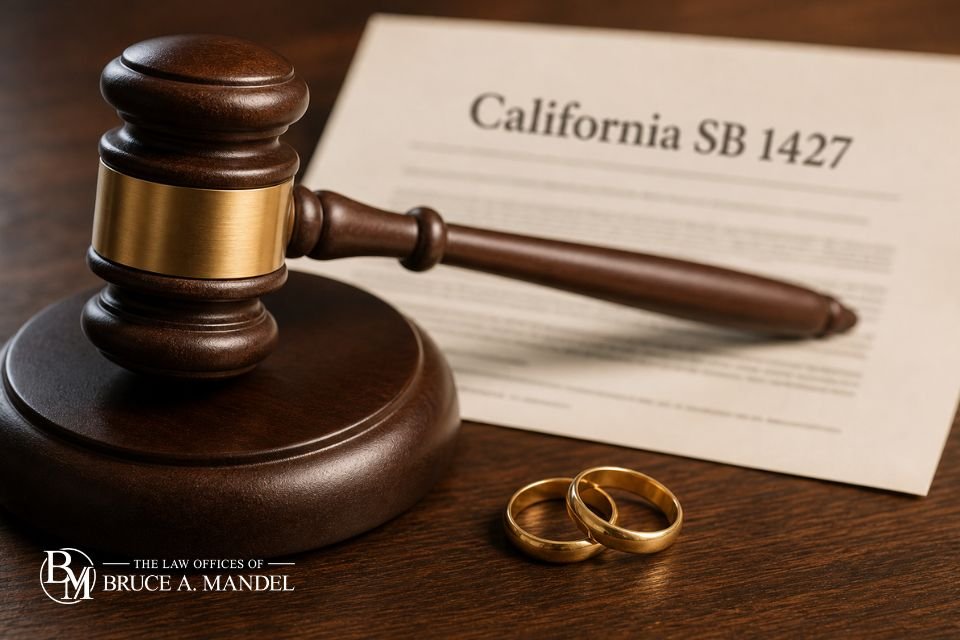
A new California law is changing how many couples approach the end of a marriage. Senate Bill 1427, effective January 1, 2026, creates a joint petition process that lets spouses file for divorce together as co-petitioners rather than as opposing parties, even if they have children or significant assets.
For couples who agree on the major issues, this option can mean a faster, more cooperative, and less expensive path through the system. The Law Offices of Bruce A. Mandel helps clients understand whether the joint petition process fits their situation and how to protect their interests while using it.
What Is the SB 1427 Joint Petition Process?
Before this law, California’s simplified divorce option, known as summary dissolution, was only available to a narrow group of couples. You had to be married less than five years, have no children, own no real property, and keep community assets under a modest limit. Anyone outside those boundaries had to file as a traditional Petitioner and Respondent, a structure that can feel adversarial from the first form.
SB 1427 removes those restrictions. Spouses can now file jointly regardless of how long they were married, whether they have minor children, or how much property and debt they share. Both spouses appear as equal petitioners on the new mandatory forms, and the case moves forward as a shared filing instead of one spouse against the other.
Why This Law Is a Big Change for Families
The joint petition process rests on a simple idea: if two people already agree on how to divide their lives, the process should not force them into a combative structure.
Couples still must exchange full financial disclosures and reach agreement on every major issue before filing, including custody, support, and property division. What changes is the tone and the paperwork, not the underlying legal requirements.
This shift can also mean real savings. Traditional divorces in California can average around $17,500 once attorney fees and court costs are factored in. A joint petition, filed correctly, can bring the filing cost down to a few hundred dollars, though couples should still expect to invest in some legal guidance for more complex cases.
Who Can Benefit From the Joint Petition Option
Couples considering this route generally share a few common traits. You may be a good fit for a joint petition if:
- You and your spouse already agree on how to divide property, debts, and any retirement accounts.
- You have reached an understanding on child custody, visitation, and child support, if you have children together.
- Neither spouse feels pressured or unable to speak freely during negotiations.
- You are both willing to complete full financial disclosures honestly and without withholding information.
- You want to avoid the cost and delay of a contested court battle and are open to working collaboratively.
Meeting these conditions does not mean handling every detail alone. Many couples still benefit from having an attorney review the proposed judgment before it is submitted to the court.
When a Joint Petition May Not Be the Right Fit
The joint petition process depends entirely on agreement. If one spouse is hiding assets, refusing to negotiate in good faith, or using delay as a tactic, this streamlined path will not work as intended. Cases involving domestic violence, a significant power imbalance, or a serious dispute over custody are usually better served by the traditional filing process, where the court can enforce deadlines.
Some couples discover they agree on more than expected but still need help resolving a sticking point or two. In those situations, mediation or limited attorney involvement can bridge the gap.
How Legal Guidance Still Fits Into the Process
Filing jointly does not mean giving up independent legal advice. Each spouse benefits from having their own attorney review the terms before signing, since the joint petition and proposed judgment become legally binding once approved. A family law attorney can confirm support calculations are accurate and paperwork is complete before it reaches a judge.
Even in the most amicable cases, an attorney can catch issues that are easy to miss without legal training, such as an incomplete asset disclosure, a support calculation that does not reflect current guidelines, or a custody schedule that does not hold up as children get older. Catching these details before filing can prevent the need to modify the judgment later.
Moving Forward Under SB 1427
California’s new joint petition law gives many couples a faster, more respectful, and more affordable way to end a marriage. It will not replace traditional divorce filings for every family, but for those ready to work together, it can significantly reduce conflict, cost, and time in court.
The Law Offices of Bruce A. Mandel helps clients evaluate whether the joint petition process fits their situation and review settlement terms before filing. Contact The Law Offices of Bruce A. Mandel to discuss your next steps if you and your spouse are considering this as an option.